Amazon Sellers Were Stalling Out Before They Ever Connected an Account
Mayan's self-serve signup asked new sellers to hand over Amazon account access to an unfamiliar tool before showing them any value, and most had never connected a third-party tool to that account before.
Setup asked for trust before it had earned any
Mayan is an Amazon FBA automation platform, helping sellers manage advertising and operations across marketplaces. New sellers were churning before activation: they struggled to connect their Amazon accounts, pick the right marketplace, and finish setup in one sitting.
Drop-off at onboarding directly hurt trial-to-paid conversion. Support was spending hours walking sellers through setup by hand instead of the product doing it. Leadership flagged onboarding as a blocker to scaling acquisition, not just a rough edge.
Most sellers had never done this before
Of the sellers who answered, about three in four said they'd never connected an Amazon account to a third-party tool before. First-run clarity mattered more than power-user shortcuts.
One marketplace was never enough
Roughly six in ten sellers planning to connect said they needed two or more marketplaces, not one. Multi-account support had to be a first-class path, not an edge case bolted on later.
Team and billing lived outside the flow
Sellers couldn't invite teammates until after setup, and payment wasn't part of onboarding at all. Both happened later, in separate flows, so setup never really finished in one sitting.
The mandate was fewer steps, not prettier ones
I owned the redesign of the onboarding flow end to end: account connection, multi-marketplace setup, team invites, and payment. I worked with a PM to decide what actually had to ship in three weeks, with engineers on the Amazon API constraints that shaped what account connection could look like, and with Customer Success, who supplied the real support tickets behind the friction points.
Three-week build window
The redesign had to ship in three weeks, which ruled out a from-scratch rebuild and forced a focus on the handful of screens actually causing drop-off.
Amazon's API shaped what was possible
Account and marketplace connection had to work within Amazon's own integration constraints, worked out jointly with engineering rather than designed in isolation.
No existing benchmark to beat
This was Mayan's first real self-serve onboarding flow, so there was no internal baseline to design against, only competitor gaps and seller feedback.
Two questions shaped everything downstream
Paper sketch sessions with PM and Customer Success narrowed the problem to two how-might-we questions: how might we simplify onboarding to reduce confusion and frustration, and how might we provide clear instructions so sellers can navigate the process without help. Every screen that followed traces back to one of the two.
-
Let sellers choose their own path
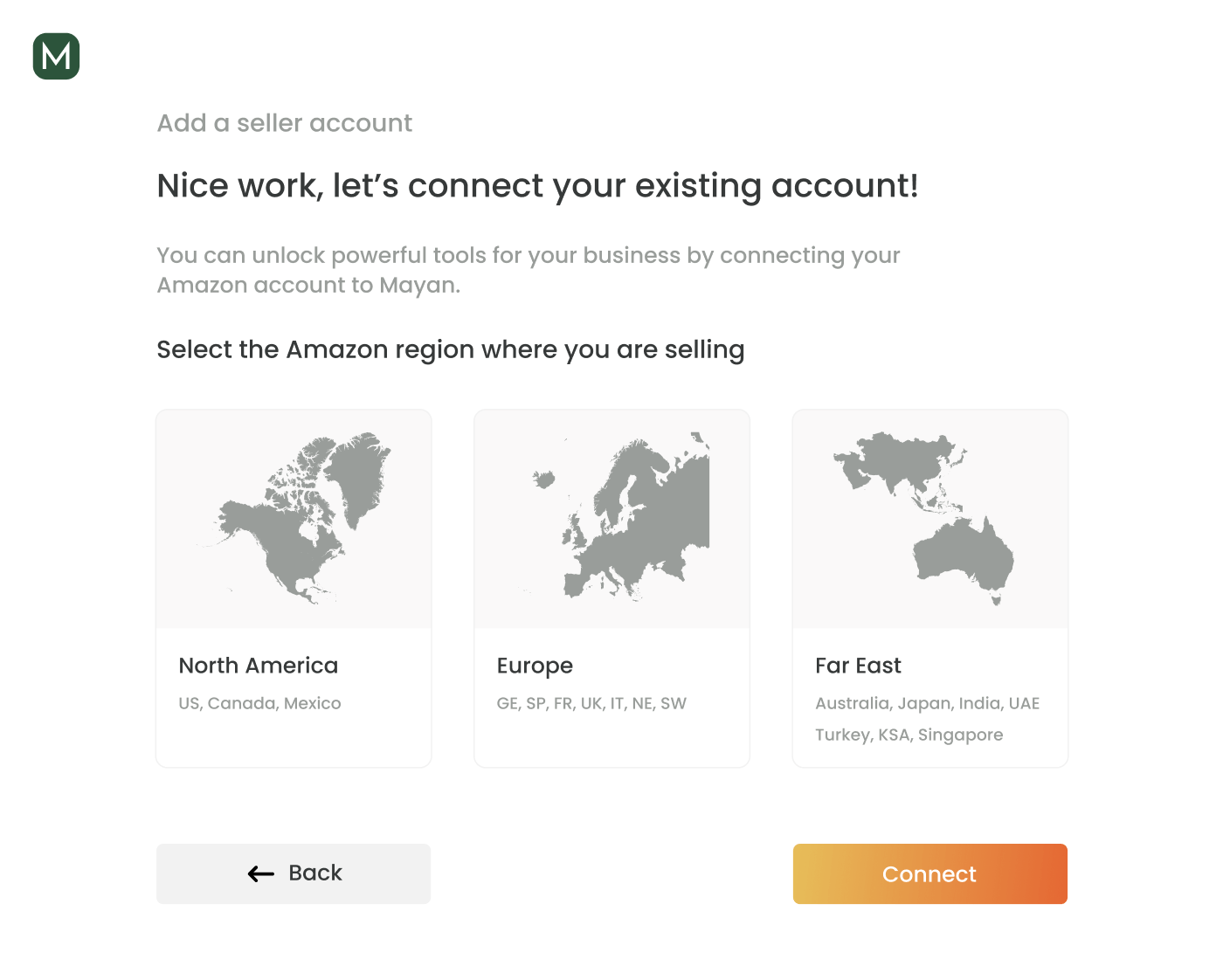
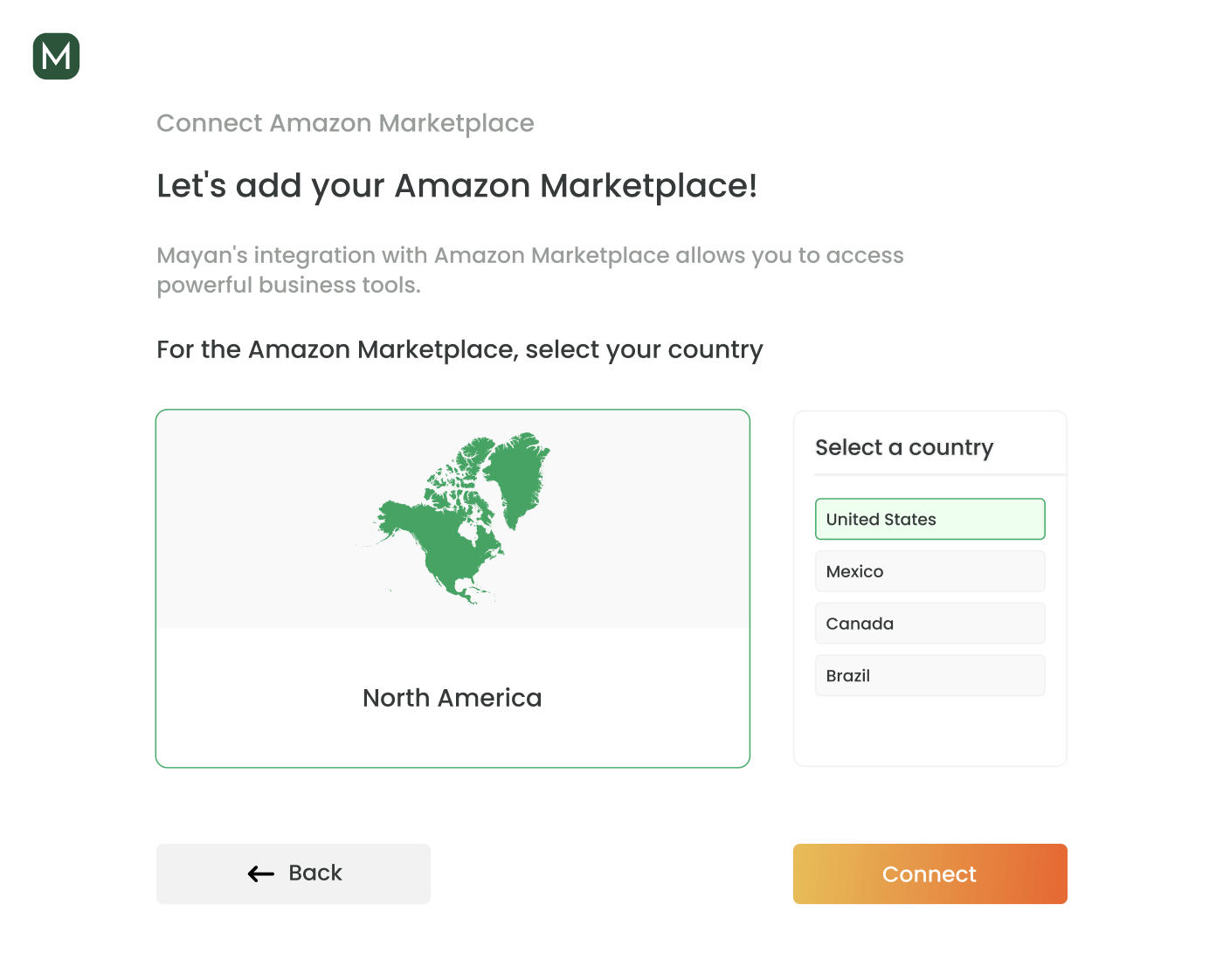
Marketplace, then region, then country, surfaced as explicit choices rather than buried in a single generic form.
-
Show sellers exactly where they stand
Clear confirmation of which account, region, and marketplace is already connected, instead of a form that gives no feedback until it fails.
-
Make team and billing additive, not mandatory
Invite people and add payment after the core account is connected, never as a gate that blocks getting there.
Research that had to fit inside three weeks
Three inputs ran in parallel rather than in sequence: a competitor review, informal outreach to sellers, and usability testing once a working prototype existed.
Five competitors, five different onboarding complaints
Teikametrics, Jungle Scout, Helium 10, Viral Launch, and AMZScout each had a distinct, recurring onboarding complaint worth designing away from rather than repeating.
| Competitor | Onboarding problem reported by users |
|---|---|
| Teikametrics | Technical friction integrating the Amazon seller account, a complex setup that took extra time to learn, and thin onboarding resources once stuck. |
| Jungle Scout | Data-accuracy concerns between estimated and actual Amazon sales figures, plus a steep learning curve and limited coverage outside the US marketplace. |
| Helium 10 | A complex interface during initial onboarding, a pricing structure that was hard to parse, and occasional data consistency issues that undercut trust. |
| Viral Launch | Limited integrations with other platforms, occasional data inaccuracies affecting research, and a perceived lack of personalized onboarding support. |
| AMZScout | Limited market coverage focused on specific regions, a less intuitive interface, and thin educational resources during onboarding. |
What sellers said, roughly
Outreach ran informally rather than through a structured research panel, so treat the numbers below as directional, not statistically precise.
That pointed at two things worth designing for immediately: first-run clarity for sellers doing this for the first time, and multi-marketplace support as a core path rather than an add-on.
Nine steps, two of them skippable
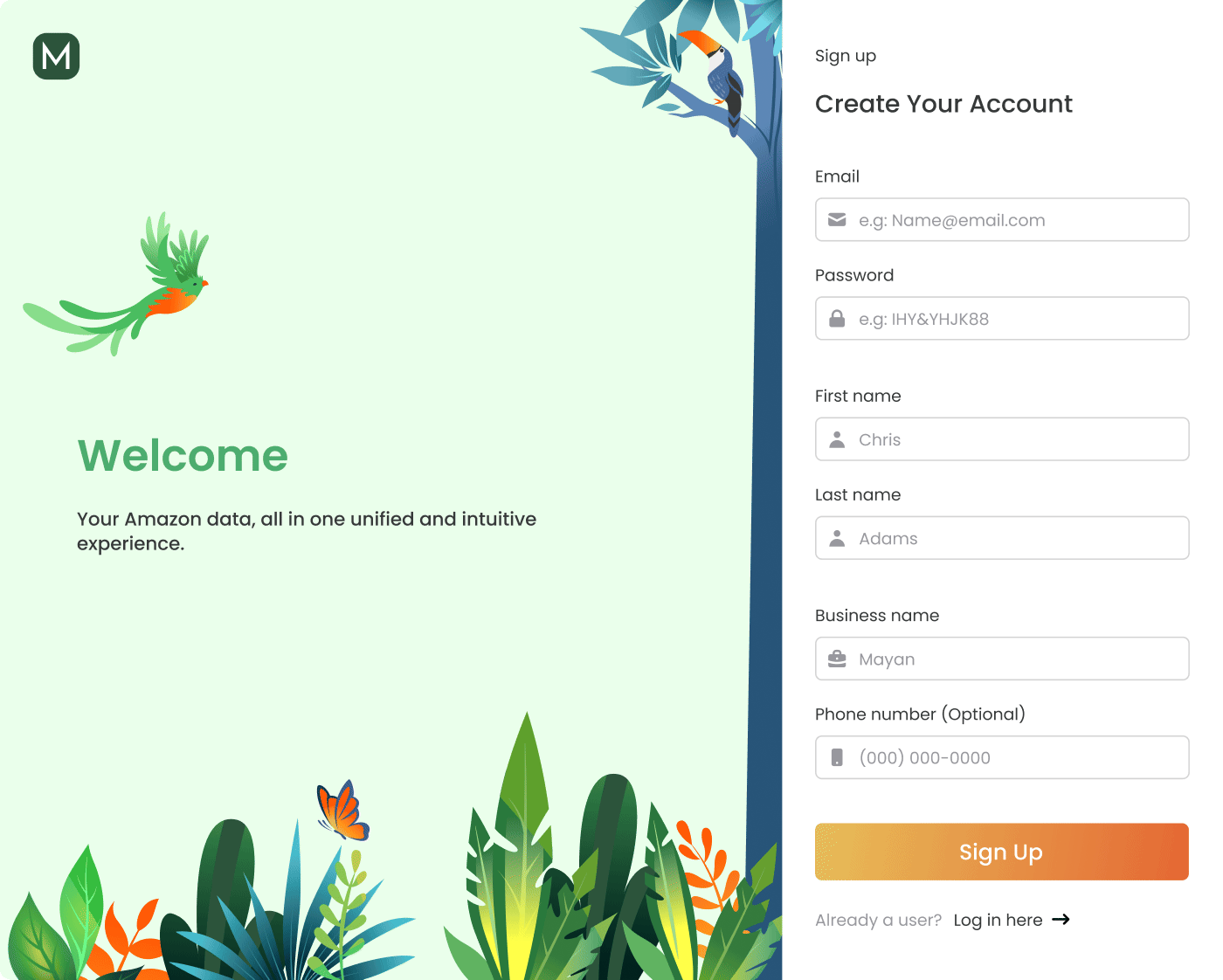
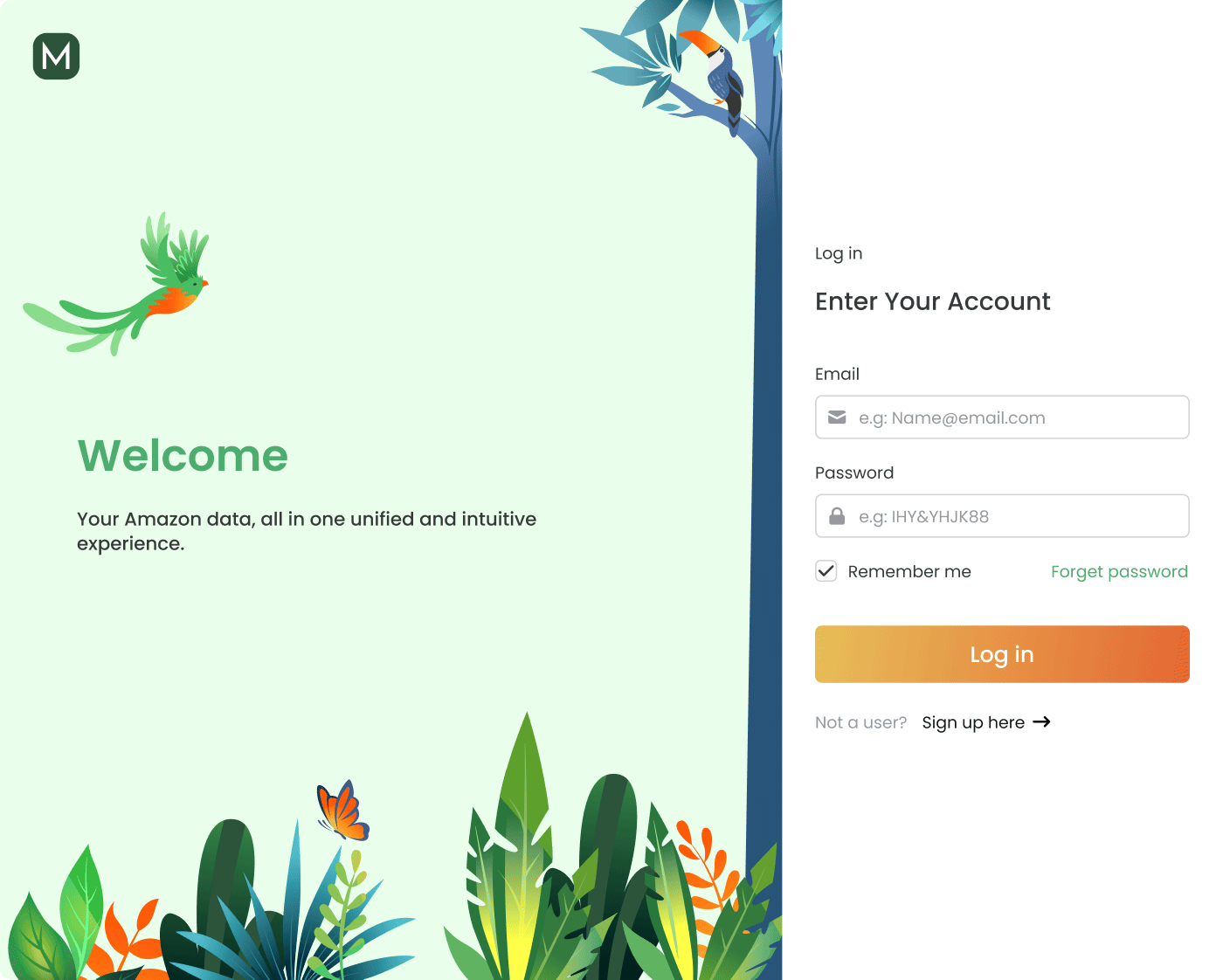
The shipped flow runs login or signup, then region, then country, connecting the marketplace once both are chosen. Two "can't connect" recovery loops sit at the region and country steps, so a failed connection sends sellers back to try again rather than into a dead end. Once connected, sellers can loop back in to add more accounts, then reach team invites and payment, both skippable, before landing on the Welcome page.
What shipped skippable, on purpose
Two decisions shaped the end of the flow more than anything else in it.
Team invites made optional, not mandatory
Blocking setup on a teammate's response would have stalled solo sellers indefinitely, so inviting people became an "add now or later" step instead of a required gate.
Payment moved to the end, with a skip
Asking for payment before a seller had seen anything connected raised the stakes of the first session. Moving it last, and making it skippable, let sellers reach a working connection before being asked to pay $900 plus 5% of ad spend a month.
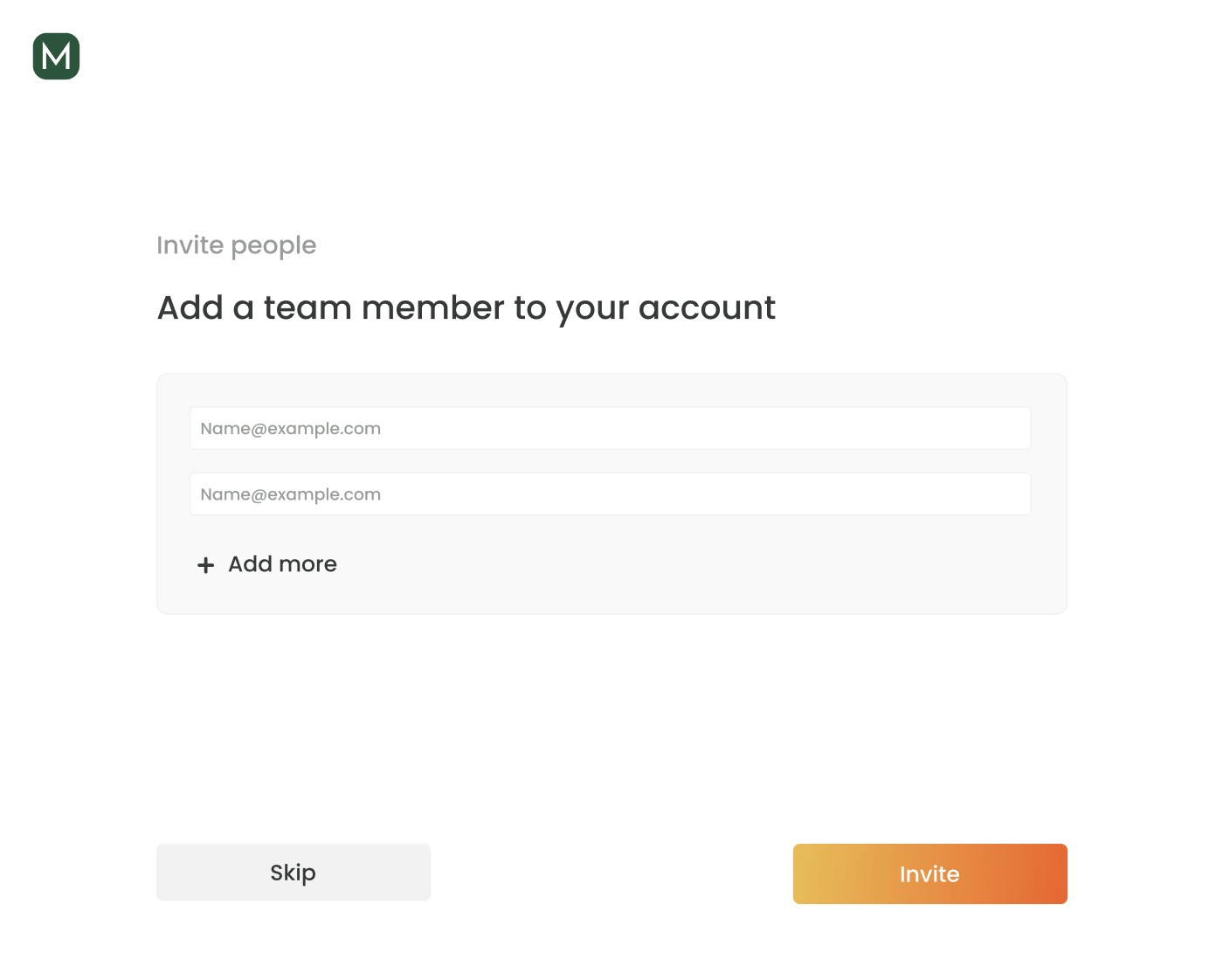
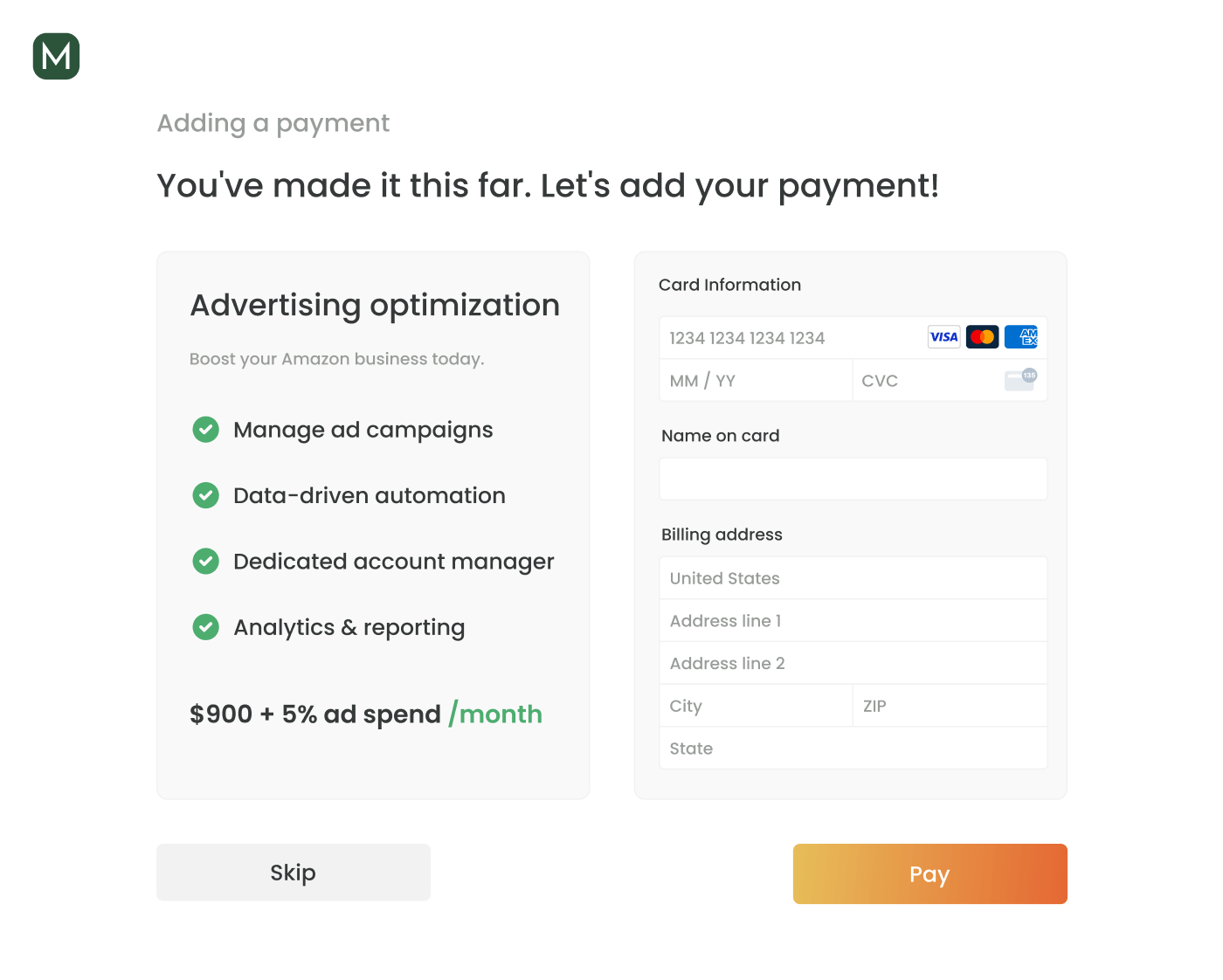
Eight sellers usability-tested the working prototype before ship. Clearer copy at the region and country steps reduced confusion. Breaking setup into progressive steps prevented the overwhelm the original single-form design caused. Letting sellers skip payment and team invites reduced early friction without stopping them from finishing account connection.
What's known, and what's still a guess
Being precise about this matters more than making it sound finished. The usability findings above were directly observed. The survey figures are directional estimates from informal outreach, not a structured study. And no analytics were wired into the shipped flow to independently verify its effect on completion after launch.
- Clearer copy at region and country steps reduced confusion
- Progressive steps prevented the overwhelm of the original single-form design
- Skippable payment and team invites reduced early friction without blocking account connection
- Most first-time sellers had never connected a third-party tool before
- Most sellers needed two or more marketplaces, not one
- A meaningful minority already sold across multiple countries
- Change in onboarding completion rate after launch
- Change in support ticket volume tied to setup
- Revenue or activation impact
This shipped inside the same window Mayan's Series A, publicly announced in March 2023, explicitly earmarked for new self-serve advertising tools launching that quarter. Self-serve onboarding sat inside that funded push, not as a side project competing for attention against it.
What I'd change next
No completion analytics shipped with it
The flow was never wired to track step-by-step drop-off after launch, so there's no independent way to verify how much the redesign actually moved completion.
The recovery loops were designed, not tested
The two "can't connect" loops back to region and country selection were built to avoid dead ends, but neither was specifically usability-tested in isolation.
Skip state wasn't tracked
Team invites and payment could be skipped, but nothing recorded how many sellers came back to finish them later versus never did.
The outreach should have been a real study
The survey numbers are useful directionally, but the next version of this research needs a structured panel with a known sample, not informal outreach.